
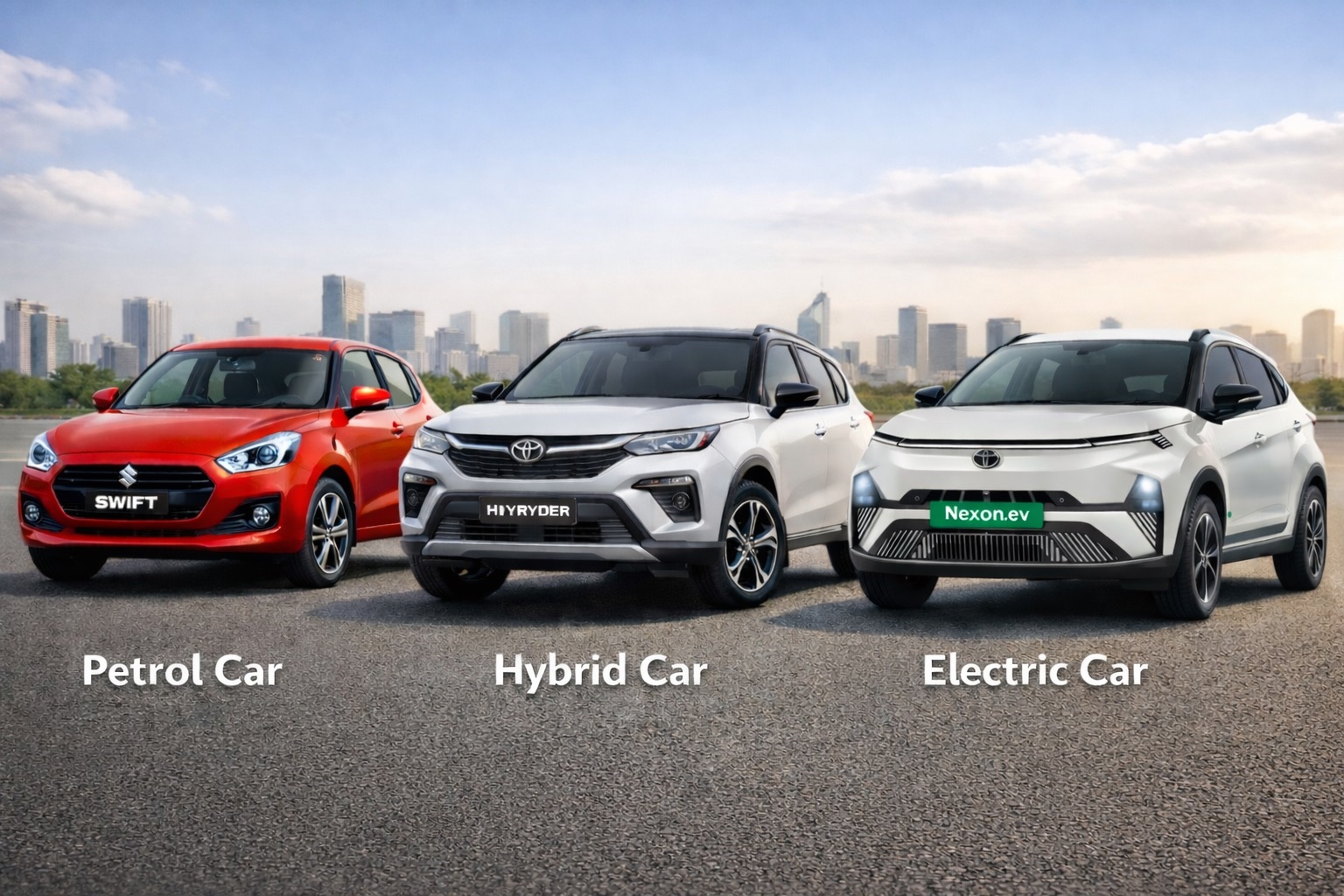
EV vs Petrol vs Hybrid Cars – Which Is More Cost Effective in India (2026)?
Choosing the right car in 2026 is no longer just about style or performance. For most buyers in India, running cost, fuel efficiency, and long-term savings matter more than ever. With rising fuel prices and the increasing popularity of electric vehicles, many people are confused between electric cars (EVs), petrol cars, and hybrid cars.
So the big question is: Which option is more cost effective in India in 2026?
In this guide, we will compare EVs, petrol cars, and hybrid cars based on purchase cost, running cost, maintenance, fuel efficiency, and long-term savings.
Understanding the Three Types of Cars
Before comparing costs, it is important to understand how each type of car works.
Electric Vehicles (EVs)
Electric vehicles run completely on electricity and use a rechargeable battery instead of a fuel engine. These cars produce zero tailpipe emissions and are considered environmentally friendly.
Common EV examples in India include the Tata Nexon EV and MG ZS EV.
Key characteristics:
· Runs entirely on electricity
· Requires charging instead of fuel
· Lower running cost
· Minimal engine maintenance
Petrol Cars
Petrol cars are the most common vehicles in India. They run on internal combustion engines that burn petrol to generate power.
They are widely available, easy to maintain, and have a large fueling infrastructure across the country.
Key characteristics:
· Lower purchase cost compared to EVs
· Easy refueling anywhere in India
· Higher fuel cost over time
· More engine maintenance required
Hybrid Cars
Hybrid cars combine a petrol engine with an electric motor. The system automatically switches between the two or uses both together to improve fuel efficiency.
Popular hybrid cars in India include models from Toyota and Honda.
Key characteristics:
· Better mileage than petrol cars
· Lower fuel consumption
· Higher purchase cost than petrol cars
· No need for external charging
Purchase Cost Comparison in India
One of the biggest differences between these vehicles is the initial purchase price.
Electric cars generally cost more because batteries are expensive. However, government incentives and subsidies have helped reduce EV prices in India.
Typical price comparison in 2026:
· Petrol cars: ₹6 lakh – ₹15 lakh
· Hybrid cars: ₹15 lakh – ₹25 lakh
· Electric cars: ₹10 lakh – ₹25 lakh
Although EVs may cost more upfront, their lower running costs can help recover the price difference over time.
Running Cost Comparison
Running cost is where the biggest difference appears.
Electric Car Running Cost
Electric cars are extremely affordable to run. Charging an EV typically costs far less than filling petrol.
Average electricity cost for EVs in India:
· Around ₹1 to ₹1.5 per km
Petrol Car Running Cost
Petrol cars are much more expensive to run because fuel prices remain high.
Average petrol car running cost:
· Around ₹6 to ₹8 per km depending on mileage and fuel price
Hybrid Car Running Cost
Hybrid cars fall somewhere between petrol and electric vehicles.
Average hybrid running cost:
· Around ₹4 to ₹5 per km
Maintenance Cost
Maintenance is another important factor when comparing cars.
EV Maintenance
Electric vehicles have fewer moving parts compared to petrol engines. This means fewer mechanical problems and lower service costs.
Typical EV maintenance benefits:
· No engine oil changes
· No gearbox maintenance
· Fewer mechanical failures
Petrol Car Maintenance
Petrol cars require regular servicing such as:
· Engine oil changes
· Filter replacements
· Engine maintenance
This increases the long-term cost.
Hybrid Car Maintenance
Hybrid cars have both electric and petrol components, which can make maintenance slightly more complex.
However, they still offer better reliability than traditional petrol vehicles.
Charging vs Fuel Availability in India
Infrastructure is an important factor when choosing a vehicle.
EV Charging Infrastructure
India's EV charging network is expanding rapidly in major cities like Delhi, Mumbai, Bangalore, and Pune. Many apartment complexes and offices are also installing charging stations.
However, charging stations are still limited in smaller cities.
Petrol Availability
Petrol pumps are available almost everywhere in India, making petrol cars the most convenient option for long-distance travel.
Hybrid Advantage
Hybrid cars do not need charging and can run entirely on petrol when needed, which makes them more practical for many users.
Long-Term Cost Comparison (5 Years)
Let’s compare approximate 5-year running costs for a typical Indian driver who drives 15,000 km per year.
Electric Car
· Total running cost: around ₹75,000 – ₹1,00,000
Petrol Car
· Total running cost: around ₹4,50,000 – ₹6,00,000
Hybrid Car
· Total running cost: around ₹3,00,000 – ₹3,75,000
This clearly shows that electric vehicles offer the lowest long-term running cost.
Which Car Should You Choose in India?
Your choice depends on your usage and location.
Choose an Electric Car if:
· You mainly drive in cities
· You want the lowest running cost
· Charging is available at home or office
Choose a Petrol Car if:
· You want the lowest upfront cost
· You travel long distances frequently
· Charging infrastructure is not available nearby
Choose a Hybrid Car if:
· You want better fuel efficiency
· You want a balance between petrol and electric
· You want convenience without charging worries